

Does Homogenization Change The Molecular Makeup Of Milk
As much as nosotros beloved great espresso, in that location is something pretty amazing about a latte or cappuccino. While we know a lot nearly the science of coffee, there doesn't seem to be about as much data available about milk and milk steaming.
Then what really happens when you lot steam milk? Why does microfoam break down after a few minutes? And why does skim milk steam differently than whole?
Using a little science, we want to help answer those questions and more. Before we get deep into the physics and chemistry of steaming, permit'south get-go with the basics—the makeup of milk.
The Makeup of Milk
With a cookie or a shot of espresso, milk is darn succulent. But what is it virtually milk that makes it and then desirable? Think of information technology this way: moo-cow's milk is substantially a dietary supplement for immature calves. Information technology'due south full of all the essential nutrients that a babe cow needs to turn into a good for you, happy heffer–namely water, saccharide, protein, fat, and minerals.
Past the numbers, water makes upwardly the bulk of milk, roughly 87%. The second well-nigh prevalent compound in milk is sugar, making up around 4.8%. Cow'due south milk has a specific kind of sugar called lactose. Lactose is why milk has a sweetness flavor when fresh, and a sour season when old (leaner in milk gradually breaks down lactose into lactic acid every bit milk ages).
Percent Concentration in Moo-cow'southward Milk
| Constituents | Range | Average |
|---|---|---|
| Water | 85.five - 89.v | 87.5 |
| Total solids | 10.5 - 14.5 | thirteen.0 |
| Fatty | 2.five - half dozen.0 | 3.9 |
| Proteins | 2.ix - five.0 | 3.iv |
| Lactose | three.half-dozen - 5.five | 4.eight |
| Minerals | 0.6 - 9.0 | 0.8 |
While it may audio like whole milk has substantially more fatty than 2% or skim, it only has 3.9% fat content on average. The fat in milk gives it a flossy texture. In not-homogenized milk, fats float around in diverse sized globules, often combining into a fat cap at the very top of the milk jug. With homogenized milk, the milk is forced through a pocket-size nozzle; this breaks upward the fats globules into uniform droplets and dispenses them evenly through the milk. Milk proteins brand up around iii.four% of the total volume of whole milk. The protein in milk is responsible for creating and stabilizing the foam. We'll circle dorsum to the result of poly peptide and fatty on milk cream in a moment.
The remaining .8% is mostly different minerals, such as calcium and magnesium. These minerals have a fairly limited outcome on the flavor and steaming qualities of the milk.
How Steaming Works
When y'all steam milk, you're essentially doing two things simultaneously: making cream by introducing air and heating the milk. For a quick refresher on milk steaming technique, check out our guide to steaming hither: How to Steam Milk. Here'southward how and why that technique works:
When you turn on your steam wand, jets of steam shoot out through the holes on the steam tip. When the steam tip is at the surface, the jets of steam act like tiny, fierce whisks–they rapidly inject air past breaking the surface of the milk and folding air into the milk. If the steam tip is overly exposed or is above the surface, large bursts of air are forced into the milk creating big, unwieldy bubbles. If the steam tip isn't exposed at all, the surface won't break; the milk volition still warm up from the hot steam just at that place won't exist any air introduced, meaning no foam.
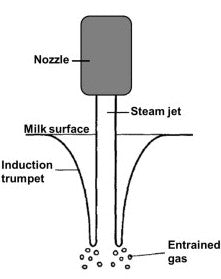
While air is getting introduced, the steam is also heating the milk. Remember those proteins from earlier? In common cold milk, they exist in tightly coiled bundles. And then, as milk warms, the proteins unwind and starting time to wrap around the air bubbles, forming a kind of protective jacket. This is because one side of the protein is hydrophobic, meaning water repellent, and the other is hydrophilic, or attracted to h2o. The hydrophobic side will cling to the air bubbles, while the hydrophilic side holds close the water in the milk. Information technology's this action that captures the air in the liquid and gives milk its unique foaming properties.
Unfortunately, if the milk gets too hot, the proteins will completely break downwards, or denature, releasing the air and ruining your foam. This is why information technology'southward important to endeavour to introduce air before the milk hits room temperature. After milk hits 100°F or room temperature, information technology is significantly harder to go those air bubbles to plow into a prissy, velvety microfoam.
Heating milk has another added do good–estrus helps enhance the perceived sweetness of milk. The longer chain carbohydrates (sugars) naturally nowadays in milk break down into simpler sugars with heat. Simply similar the difference between refined sugar and wheat, the simpler the sugar is, the easier information technology is to taste.
Steam doesn't just add air and heat the milk; the force of the steam jets moves the milk in the pitcher. By advisedly positioning the steam wand, we can use the force to stir in all the slap-up foam. Why is this important? Air is lighter than milk. If left to its own devices, it will bladder to the surface and class a thick head, almost like a freshly poured lager. While that can be nice to drink, it'south nigh impossible to pour into not bad latte art. To get the perfect steam wand position, all y'all accept to practice is set your steam wand so information technology is just off middle. You'll know you lot've hit the sweet spot when the milk spins in the pitcher like a tornado or vortex.
At present a bit of bad news–even the best microfoam will somewhen collapse. For that, we have gravity to thank. Over time, the light air bubbles rise and heavier liquid milk drains from the foam. As the liquid drains, the small bubbling combine into larger and larger bubbles. This continues until the pressure level of the air inside the chimera exceeds the force of proteins property it in and the chimera pops.

The Effect of Milk Fat on Cream
You might take heard skim milk is significantly better for foaming. Or your coffee friend swears the whole milk is the best at making luscious cappuccinos. It turns out both things are kind of authentic.
Fatty has a destabilizing issue on foam. Call up those unwinding proteins from earlier? The hydrophobic part of milk protein is as likely to attach to fat as it is to air. Information technology just wants to get every bit far away from water as possible. The more fat there is in milk, the less air information technology can hold.
With that in heed, skim milk will yield the most stable and stiff cream. Unfortunately, it'due south extremely difficult to employ this kind of foam to pour latte fine art; instead of flowing smoothly out of the pitcher, skim milk has a tendency to sort of plop into the loving cup.
Whole milk tends to produce a creamier, more flavorful foam. Let's be honest–fat tastes great (encounter the myriad uses of butter in French cuisine). It also helps produce a milk foam that is more than velvety than dry, as the foam in whole milk is really an emulsification of air, water and fat.
For more in-depth preparation, check out Intro to Milk Steaming and Latte Art now available through Coffee School.

Does Homogenization Change The Molecular Makeup Of Milk,
Source: https://clivecoffee.com/blogs/learn/the-science-behind-perfect-steamed-milk
Posted by: maddoxagaincelow1975.blogspot.com
0 Response to "Does Homogenization Change The Molecular Makeup Of Milk"
Post a Comment